
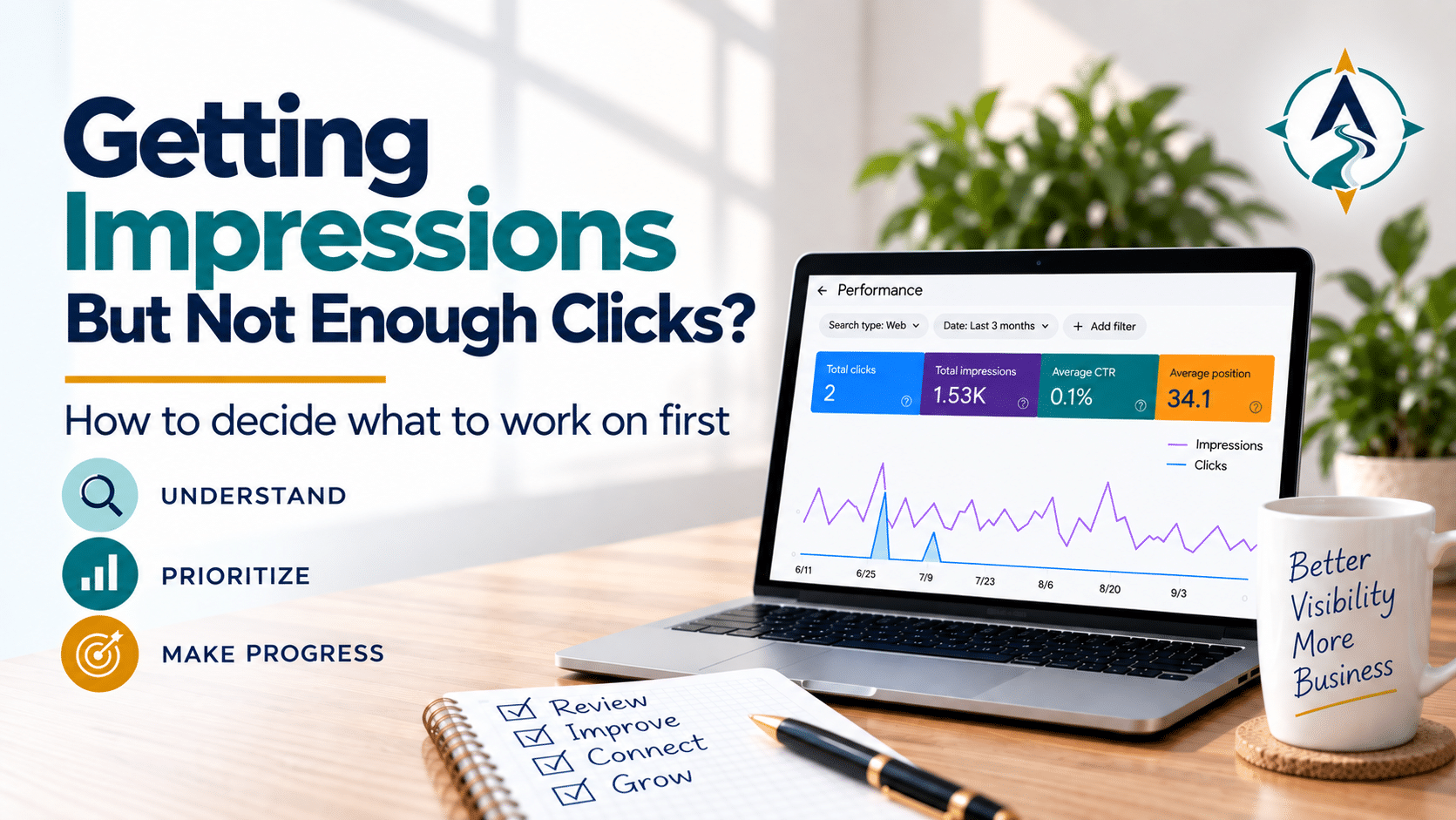
Your Website Is Getting Impressions but Not Enough Clicks. What Should You Work on First?
Seeing your website appear more often in Google Search can feel like progress. And it is.
But then you look at the clicks.
Not much has changed.
Google Search Console impressions can tell you that your visibility is growing, but impressions alone don’t tell you whether that visibility is bringing the right people to your website.
If your impressions are increasing while clicks remain low, your first instinct might be to create more pages, publish more blog posts, or start changing everything that isn’t ranking well.
I usually wouldn’t start there.
Growing impressions are giving you information. Before creating more content, I would use that information to figure out what Google is already beginning to notice and where the best opportunities may be hiding.
First, What Does an Impression Actually Tell You?
In Google Search Console, an impression generally means that a link to your website appeared in a user’s Google Search results.
It doesn’t mean the person visited your website.
That’s why you can have hundreds or thousands of impressions and relatively few clicks.
But those impressions are still valuable.
They tell you that Google is connecting pages on your website with actual searches.
Instead of looking only at the total number, start asking:
Which pages are getting those impressions?
What searches are triggering them?
Are those searches relevant to the people I actually want to reach?
Which pages appear to be gaining visibility?
That’s where Search Console starts becoming useful for making decisions rather than simply reporting numbers.
Don’t Treat Every Page the Same
One of the biggest mistakes you can make is looking at your website as one big SEO project.
Individual pages can be performing very differently.
You may have one service page receiving hundreds of relevant impressions while another barely appears at all.
That first page is already giving you a signal.
Rather than immediately creating another page, I would investigate the page that’s beginning to gain traction.
Look at the search queries associated with it.
Are people finding the page for the service you intended?
Are they using slightly different language than you expected?
Are there questions or related topics appearing that the page doesn’t answer particularly well?
Sometimes the next opportunity isn’t another piece of content.
It’s making an existing page more useful.
Look for Pages That Are Close to an Opportunity
I pay particular attention to pages that are already appearing for relevant searches but aren’t yet producing the results I’d like.
For example, imagine a local service page is receiving a growing number of impressions.
The page clearly has some relevance in Google’s eyes.
Before replacing it or creating several new pages around the same topic, I would look at things such as:
Search intent: Does the page actually answer what the searcher appears to want?
Page title and search snippet: If people see the result, does it give them a compelling reason to click?
Content: Does the page thoroughly answer the important questions someone would have before hiring the business?
Internal links: Are other relevant pages on the website pointing visitors and search engines toward this page?
Local relevance: If the business serves a geographic area, does the page provide useful local context rather than simply mentioning a city name?
Next step: Once someone reaches the page, is it obvious what they should do?
These improvements often deserve attention before adding more content to the publishing calendar.
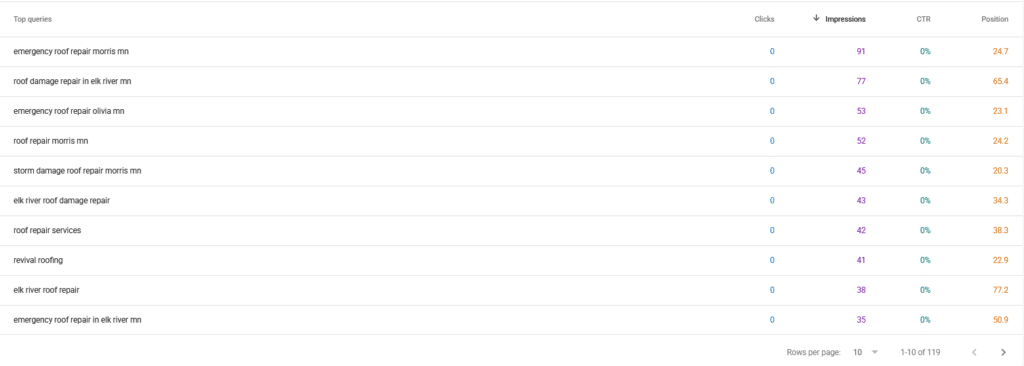
A roofing service page I reviewed had appeared in Google Search more than 1,500 times over three months, but generated only two clicks. At first glance, that might look like a simple click through rate problem.
Looking at the search queries told a different story.
Google was already associating the page with dozens of relevant searches for roof repair, emergency repair, storm damage and roof leaks. The problem wasn’t simply whether Google understood the service. Many of the strongest impressions were coming from locations outside the company’s primary service area, while some searches closer to its core market were ranking much lower.
That changes the question from “How do we get more impressions?” to “How do we strengthen the right visibility?”
And that leads to a very different action plan.
| Search query | Impressions | Position |
|---|---|---|
| emergency roof repair morris mn | 91 | 24.7 |
| emergency roof repair olivia mn | 53 | 23.1 |
| roof repair morris mn | 52 | 24.2 |
| storm damage roof repair morris mn | 45 | 20.3 |
| repair missing roof shingles glyndon mn | 33 | 15.2 |
You can see more of the website structure and local SEO work behind this project in my Revival Roofing case study
Google Search Console Impressions Can Help You Prioritize
This is one reason I like using Search Console as a decision making tool.
Instead of asking:
“What should we write next?”
I can ask:
“What is Google already telling us about the website?”
Suppose you discover:
- A service page with rapidly growing impressions
- An important page appearing near the bottom of page one or somewhere on page two
- A page showing for valuable searches but getting very few clicks
- Several pages appearing for searches that should probably be handled by one stronger page
- A location page beginning to appear for searches in an important service area
Those aren’t just statistics.
They’re clues about where your next hour of work may produce more value.
Sometimes the Problem Is Internal Linking
A strong page can still be surprisingly isolated within a website.
Maybe it appears in the main navigation, but few related pages actually link to it.
Or perhaps you’ve written several useful articles that discuss the same service without ever directing readers to the primary service page.
Internal links help people discover related information, but they also help search engines understand how the pages on your website relate to one another.
If an important page is gaining impressions, I like to look at the rest of the site and ask:
Where would it genuinely help a visitor to link to this page?
That could be from:
- Related service pages
- Location pages
- Helpful articles
- Frequently asked questions
- Project or case study pages
- Relevant sections of the homepage
The goal isn’t to add links everywhere.
It’s to make the website more connected and useful.
More Content Isn’t Always the Answer
Publishing new content can absolutely be worthwhile.
But there is a difference between publishing because you identified a real opportunity and publishing because your marketing calendar says you need another blog post.
Before creating something new, I like to ask:
Do we already have a page that should address this?
If the answer is yes, improving that page may make more sense.
If the answer is no, then new content might be exactly what is needed.
That distinction can save a small business from accumulating dozens of thin, overlapping, or forgotten pages.
Look Beyond Google Search Too
Search visibility is only one part of your digital presence.
For a local business, I may also look at:
- Google Business Profile
- Reviews
- Photos and recent business activity
- Important service and location pages
- Website navigation
- Calls to action
- Existing articles
- Social or video content that could be reused
- Content that exists on one platform but nowhere else
Sometimes the most valuable next step isn’t an SEO change at all.
A business might already have a library of videos, podcasts, articles, presentations, or frequently asked questions that could be doing far more work.
That’s why I prefer looking at the digital presence as a connected system rather than treating SEO, the website, social media, and content as completely separate projects.
If you’re working on improving your visibility in local searches, I’ve also put together a guide on how to get your small business found on Google. It covers the different pieces that help customers discover your business online.
Decide What Matters Now and What Can Wait
This may be the most important part.
Once you start analyzing a website, it is very easy to create a list of 50 things that could be improved.
That doesn’t mean all 50 deserve attention.
I would rather identify a handful of meaningful priorities and work through them deliberately.
A simple 30 day plan might include:
Week 1: Strengthen one important page that’s already gaining visibility.
Week 2: Improve internal links pointing to that page and related services.
Week 3: Create one genuinely useful supporting article based on an identified search or customer need.
Week 4: Review what changed and decide what deserves attention next.
Your plan may look completely different.
That’s the point.
The best next step should come from what your business and your existing digital presence are actually telling you.
You May Already Have More to Work With Than You Think
You don’t necessarily need more content, more platforms, or a larger marketing plan.
Sometimes you need a clearer understanding of what you already have.
Look at what’s beginning to work.
Find the pages and content that deserve more attention.
Connect the pieces that should be working together.
Then decide what actually needs to be created next.
Not Sure What Deserves Your Attention First?
My Digital Presence Audit + 30 Day Action Plan is designed for small businesses that have an online presence but aren’t sure where to focus next.
I’ll review what you already have, identify the opportunities most worth your attention, and organize my recommendations into a practical 30 day plan.
You can implement the recommendations yourself or ask me to help.